- Quiz will start as soon as you click the ‘Start Quiz‘ button below.
- Question will come one by one click on next for next question
- There are 30 questions in this quiz, you will get 30 Minutes to attempt.
- 2 Marks is determined for the correct answer for each question. There is no negative marking for incorrect answer.
- After the quiz is over, in order to know your rank in the Ranking List / Leader-board below, you should enter your name and email address, otherwise you will be deprived of it.
- After completing click on finish Quiz
- To see correct answers click on view Question
- जैसे ही आप नीचे दिए गए ‘स्टार्ट क्विज़’ बटन पर क्लिक करेंगे, क्विज़ शुरू हो जाएगा।
प्रश्न अगले प्रश्न के लिए अगले एक क्लिक पर आएगा
इस क्विज में 30 प्रश्न हैं, आपको प्रयास करने के लिए 30 मिनट मिलेंगे।
प्रत्येक प्रश्न के सही उत्तर के लिए 2 अंक निर्धारित किए गए हैं। गलत उत्तर के लिए कोई नकारात्मक अंकन नहीं है।
प्रश्नोत्तरी समाप्त होने के बाद, नीचे दी गई रैंकिंग सूची / लीडर-बोर्ड में अपनी रैंक जानने के लिए, आपको अपना नाम और ईमेल पता दर्ज करना चाहिए, अन्यथा आप इससे वंचित रह जाएंगे।
फिनिश क्विज़ पर क्लिक करने के बाद
सही उत्तर देखने के लिए प्रश्न पर क्लिक करें
Paper 2 CS System Software & Operating System Part 5
Quiz-summary
0 of 30 questions completed
Questions:
- 1
- 2
- 3
- 4
- 5
- 6
- 7
- 8
- 9
- 10
- 11
- 12
- 13
- 14
- 15
- 16
- 17
- 18
- 19
- 20
- 21
- 22
- 23
- 24
- 25
- 26
- 27
- 28
- 29
- 30
Information
Paper 1 Quiz helps u to Excel in NET JRF
Paper 1 All questions 2 Marks each
- Navdeep Kaur
- All the Best
You have already completed the quiz before. Hence you can not start it again.
Quiz is loading…
You must sign in or sign up to start the quiz.
You have to finish following quiz, to start this quiz:
Results
0 of 30 questions answered correctly
Your time:
Time has elapsed
You have reached 0 of 0 points, (0)
| Average score |
|
| Your score |
|
Categories
- Not categorized 0%
-
Average marks Improve next time All the Best
-
Nice Keep it up, Stay Blessed
-
Awesome Great Marks, Keep doing
| Pos. | Name | Entered on | Points | Result |
|---|---|---|---|---|
| Table is loading | ||||
| No data available | ||||
- 1
- 2
- 3
- 4
- 5
- 6
- 7
- 8
- 9
- 10
- 11
- 12
- 13
- 14
- 15
- 16
- 17
- 18
- 19
- 20
- 21
- 22
- 23
- 24
- 25
- 26
- 27
- 28
- 29
- 30
- Answered
- Review
-
Question 1 of 30
1. Question
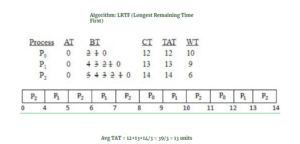
2 pointsConsider three processes(process id 0,1,2 respectively) with compute time bursts 2,4 and 8 time units. All processes arrive at time zero. Consider the Longest remaining time first(LRTF) scheduling algorithm. In LRTF ties are broken by giving priority to the process with the lowest process id. The average turnaround time is:
Correct
 Incorrect
-
Question 2 of 30
2. Question
2 pointsBanker’s algorithm is used for:
Correct
Banker’s algorithm is used for Deadlock avoidance.
Incorrect
Banker’s algorithm is used for Deadlock avoidance.
-
Question 3 of 30
3. Question
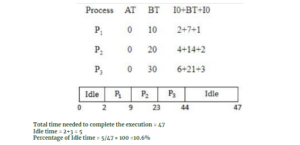
2 pointsConsider three processes, all arriving at time zero, with total execution time of 10,20 and 30 units, respectively. Each process spends the first 20% of execution time doing I/O, the next 70% of time doing computations, and the last 10% of time doing I/O again. The operating system uses a shortest remaining compute time first scheduling algorithm and schedules a new process either when the running process gets blocked on I/O or when the running process finishes its compute burst. Assume that all I/O operations can be overlapped as much as possible. For what percentage f time does the CPU remain idle?
Correct
 Incorrect
-
Question 4 of 30
4. Question
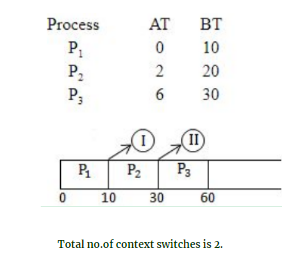
2 pointsConsider three CPU-intensive processes which require 10,20 and 30 time units and arrive at times 0,2 and 6, respectively. How arrive at times 0,2 and 6, respectively. How many context switches are needed if the operating system implements a shortest remaining time first scheduling algorithm? Do not count the context switches at time zero and at the end.
Correct
 Incorrect
-
Question 5 of 30
5. Question
2 pointsWhich of the following process scheduling algorithm may lead to starvation?
Correct
“● Starvation is method in which process with high priorities continuously uses the resources preventing low priority process to acquire the resources
● In the Shortest job next scheduling shortest job process will run first and later higher burst time.Here the process with higher burst time need to wait for longer time.
“Incorrect
“● Starvation is method in which process with high priorities continuously uses the resources preventing low priority process to acquire the resources
● In the Shortest job next scheduling shortest job process will run first and later higher burst time.Here the process with higher burst time need to wait for longer time.
“ -
Question 6 of 30
6. Question
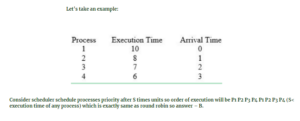
2 pointsA scheduling algorithm assigns priority proportional to the waiting time of a process. Every process starts with priority zero(the lowest priority). The scheduler re-evaluates the process priorities every T time units and decides the next process to schedule. Which one of the following is TRUE if the processes have no I/O operations and all arrive at time zero?
Correct
 Incorrect
-
Question 7 of 30
7. Question
2 pointsSuppose two jobs, each of which needs 10 minutes of CPU time, start simultaneously. Assume 50% I/O wait time. How long will it take for both to complete, if they run sequentially?
Correct
“Given data,
2 jobs need 10 min CPU time,
50% IO waiting time
Step-1: Here, total CPU time is IO operation time and execution time.
Step-2: We can assume, CPU time = (IO operation time*execution time) =2 times
Step-3: CPU running both the process is 10+10 mins.
1 CPU time=20 mins.
Step-4: Need= 2 times *20 min
=40mins.
Note: Actual answer key, they given Option C
“Incorrect
“Given data,
2 jobs need 10 min CPU time,
50% IO waiting time
Step-1: Here, total CPU time is IO operation time and execution time.
Step-2: We can assume, CPU time = (IO operation time*execution time) =2 times
Step-3: CPU running both the process is 10+10 mins.
1 CPU time=20 mins.
Step-4: Need= 2 times *20 min
=40mins.
Note: Actual answer key, they given Option C
“ -
Question 8 of 30
8. Question
2 pointsWhich of the following scheduling algorithm could result in starvation?
Correct
Priority scheduling algorithm could result starvation. Starvation is nothing but indefinite blocking.
Incorrect
Priority scheduling algorithm could result starvation. Starvation is nothing but indefinite blocking.
-
Question 9 of 30
9. Question
2 pointsConsider a system having ‘m’ resources of the same type. these resources are shared by 3 processes A,B,C; which have peak time demands of 3,4,6 respectively. The minimum value of ‘m’ that ensures that deadlock will never occur is
Correct
“A requires 3, B-4, C-6;
→ If A have 2, B have 3, C have 5 then deadlock will occur i.e., 2+3+5=10.
→ If we have one extra resource then deadlock will not occur i.e., 10+1=11.
→ If we have equal (or) more than 11 resources then deadlock will never occur.
“Incorrect
“A requires 3, B-4, C-6;
→ If A have 2, B have 3, C have 5 then deadlock will occur i.e., 2+3+5=10.
→ If we have one extra resource then deadlock will not occur i.e., 10+1=11.
→ If we have equal (or) more than 11 resources then deadlock will never occur.
“ -
Question 10 of 30
10. Question
2 pointsWhich of the following is added to page table in order to track whether a page of cache has been modified since it was read from the memory?
Correct
“→ A dirty bit (or) modified bit is a bit that is associated with a block of computer memory and indicates whether or not the corresponding block of memory has been modified. The dirty bit is set when the processor writes to (modifies) this memory.
→ The bit indicates that its associated block of memory has been modified and has not been saved to storage yet. When a block of memory is to be replaced, its corresponding dirty bit is checked to see if the block needs to be written back to secondary memory before being replaced or if it can simply be removed.
→ Dirty bits are used by the CPU cache and in the page replacement algorithms of an operating system.
→ Dirty bits can also be used in Incremental computing by marking segments of data that need to be processed or have yet to be processed.
“Incorrect
“→ A dirty bit (or) modified bit is a bit that is associated with a block of computer memory and indicates whether or not the corresponding block of memory has been modified. The dirty bit is set when the processor writes to (modifies) this memory.
→ The bit indicates that its associated block of memory has been modified and has not been saved to storage yet. When a block of memory is to be replaced, its corresponding dirty bit is checked to see if the block needs to be written back to secondary memory before being replaced or if it can simply be removed.
→ Dirty bits are used by the CPU cache and in the page replacement algorithms of an operating system.
→ Dirty bits can also be used in Incremental computing by marking segments of data that need to be processed or have yet to be processed.
“ -
Question 11 of 30
11. Question
2 pointsThe time taken to switch between user and kernel modes of execution be t1 while the time taken to switch between two processes be t2. Which of the following is TRUE?
Correct
“→ A context switch (also sometimes referred to as a process switch or a task switch) is the switching of the CPU (central processing unit) from one processor thread to another.
→ Context switches can occur only in kernel mode. Kernel mode is a privileged mode of the CPU in which only the kernel runs and which provides access to all memory locations and all other system resource
→ Other programs, including applications, initially operate in user mode, but they can run portions of the kernel code via system calls
→ The existence of these two modes in Unix-like operating systems means that a similar, but simpler, operation is necessary when a system call causes the CPU to shift to kernel mode. This is referred to as a mode switch rather than a context switch, because it does not change the current process.
→ Context switch between the processes involves mode switch also.”Incorrect
“→ A context switch (also sometimes referred to as a process switch or a task switch) is the switching of the CPU (central processing unit) from one processor thread to another.
→ Context switches can occur only in kernel mode. Kernel mode is a privileged mode of the CPU in which only the kernel runs and which provides access to all memory locations and all other system resource
→ Other programs, including applications, initially operate in user mode, but they can run portions of the kernel code via system calls
→ The existence of these two modes in Unix-like operating systems means that a similar, but simpler, operation is necessary when a system call causes the CPU to shift to kernel mode. This is referred to as a mode switch rather than a context switch, because it does not change the current process.
→ Context switch between the processes involves mode switch also.” -
Question 12 of 30
12. Question
2 pointsA system has 3 processes sharing 4 resources. If each process needs a maximum of 2 units then, deadlock.
Correct
If the system is deadlocked, it implies that each process is holding one resource and is waiting for one more. Since there are 3 processes and 4 resources, one process must be able to obtain two resources. This process requires no more resources and therefore it will return its resources when done.
Incorrect
If the system is deadlocked, it implies that each process is holding one resource and is waiting for one more. Since there are 3 processes and 4 resources, one process must be able to obtain two resources. This process requires no more resources and therefore it will return its resources when done.
-
Question 13 of 30
13. Question
2 pointsWhich of the following is the first module of a language processing system?
Correct
“→ Preprocessor is a program that processes its input data to produce output that is used as input to another program.
→ The output is said to be a preprocessed form of the input data, which is often used by some subsequent programs like compilers.
→ The amount and kind of processing done depends on the nature of the preprocessor.
→ Preprocessor is the first module of a language processing system.
“Incorrect
“→ Preprocessor is a program that processes its input data to produce output that is used as input to another program.
→ The output is said to be a preprocessed form of the input data, which is often used by some subsequent programs like compilers.
→ The amount and kind of processing done depends on the nature of the preprocessor.
→ Preprocessor is the first module of a language processing system.
“ -
Question 14 of 30
14. Question
2 pointsThe total number of page faults for the reference string 1,2,3,4,5,6,7,8,9,10 using FIFO page replacement policy for a process m if 3 frames are allocated to its are:
Correct
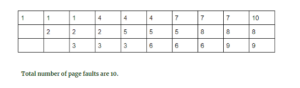 Incorrect
-
Question 15 of 30
15. Question
2 pointsThe address sequence generated by tracing a particular program executing in a pure demand paging system with 100 records per page, with 1 free main memory fram is recorded as follows. What is the number of page faults? 0100, 0200, 0430, 0499, 0510, 0530, 0560, 0120, 0220, 0240, 0260, 0320, 0370
Correct
“→ Page are fitted in frames, so first we need to determine the pages but given request are just the record request in decimal. We can assume that first page to address from 0000 to 0099 and page 2 contains records from 0100 to 0199 and so on (it is given in question that each page contains 100 records) and so on. So page request string is
01, 02, 04, 04, 05, 05, 05, 01, 02, 02, 02, 03, 03.
Clearly 7 page faults.”Incorrect
“→ Page are fitted in frames, so first we need to determine the pages but given request are just the record request in decimal. We can assume that first page to address from 0000 to 0099 and page 2 contains records from 0100 to 0199 and so on (it is given in question that each page contains 100 records) and so on. So page request string is
01, 02, 04, 04, 05, 05, 05, 01, 02, 02, 02, 03, 03.
Clearly 7 page faults.” -
Question 16 of 30
16. Question
2 points“State whether TRUE or FALSE
(i) Shortest remaining time (SRT) algorithm is the preemptive version of the shortest job next(SJN) CPU scheduling algorithm
(ii) A “context switch” is the mechanism to store and restore the state or context of a CPU in PCB”Correct
“TRUE: Shortest remaining time (SRT) algorithm is the preemptive version of the shortest job next(SJN) CPU scheduling algorithm.
TRUE: A “context switch” is the mechanism to store and restore the state or context of a CPU in PCB.”Incorrect
“TRUE: Shortest remaining time (SRT) algorithm is the preemptive version of the shortest job next(SJN) CPU scheduling algorithm.
TRUE: A “context switch” is the mechanism to store and restore the state or context of a CPU in PCB.” -
Question 17 of 30
17. Question
2 pointsOperating system maintains the page table for:
Correct
“Role of the page table
→ In operating systems that use virtual memory, every process is given the impression that it is working with large, contiguous sections of memory.
→ Physically, the memory of each process may be dispersed across different areas of physical memory, or may have been moved (paged out) to another storage, typically to a hard disk drive.
→ When a process requests access to data in its memory, it is the responsibility of the operating system to map the virtual address provided by the process to the physical address of the actual memory where that data is stored.
→ The page table is where the operating system stores its mappings of virtual addresses to physical addresses, with each mapping also known as a page table entry (PTE).
“Incorrect
“Role of the page table
→ In operating systems that use virtual memory, every process is given the impression that it is working with large, contiguous sections of memory.
→ Physically, the memory of each process may be dispersed across different areas of physical memory, or may have been moved (paged out) to another storage, typically to a hard disk drive.
→ When a process requests access to data in its memory, it is the responsibility of the operating system to map the virtual address provided by the process to the physical address of the actual memory where that data is stored.
→ The page table is where the operating system stores its mappings of virtual addresses to physical addresses, with each mapping also known as a page table entry (PTE).
“ -
Question 18 of 30
18. Question
2 pointsNon contiguous memory allocation splits program into blocks of memory called ___ that can be loaded in non adjacent holes in main memory
Correct
Noncontiguous memory allocation splits programs into blocks of memory called Segments that can be loaded into non adjacent “holes” in main memory.
Incorrect
Noncontiguous memory allocation splits programs into blocks of memory called Segments that can be loaded into non adjacent “holes” in main memory.
-
Question 19 of 30
19. Question
2 pointsA 3.5 inch micro floppy high density disk contains he data__
Correct
“→ The 3.5-Inch floppy diskettes have dimensions of 8.9cm in width by 9.3cm in height and are referred to as floppies because of the circular magnetic floppy within the hard shell.
→ 3.5-inch floppy diskettes come in sizes of 720 KB low-density, 1.44 MB high density capacity, and IBM even developed an Extended Density disk capable of holding 2.88 MB.”Incorrect
“→ The 3.5-Inch floppy diskettes have dimensions of 8.9cm in width by 9.3cm in height and are referred to as floppies because of the circular magnetic floppy within the hard shell.
→ 3.5-inch floppy diskettes come in sizes of 720 KB low-density, 1.44 MB high density capacity, and IBM even developed an Extended Density disk capable of holding 2.88 MB.” -
Question 20 of 30
20. Question
2 pointsWhat is compaction?
Correct
“→ Compaction refers to combining all the empty spaces together and processes. Compaction helps to solve the problem of fragmentation, but it requires too much of CPU time.
→ It moves all the occupied areas of store to one end and leaves one large free space for incoming jobs, instead of numerous small ones.
→ In compaction, the system also maintains relocation information and it must be performed on each new allocation of job to the memory or completion of job from memory.”Incorrect
“→ Compaction refers to combining all the empty spaces together and processes. Compaction helps to solve the problem of fragmentation, but it requires too much of CPU time.
→ It moves all the occupied areas of store to one end and leaves one large free space for incoming jobs, instead of numerous small ones.
→ In compaction, the system also maintains relocation information and it must be performed on each new allocation of job to the memory or completion of job from memory.” -
Question 21 of 30
21. Question
2 pointsProcess is in a ready state____
Correct
When process is unable to run until some task has been completed, the process is in blocked state and if process is using the CPU, it is in running state.
Incorrect
When process is unable to run until some task has been completed, the process is in blocked state and if process is using the CPU, it is in running state.
-
Question 22 of 30
22. Question
2 points“How many times the word “”PROCESS”” will be printed when executing the following program?
main()
{
printf(“”process””);
fflush();
fork();
fork();
}
“Correct
“→ fflush() is typically used for output stream only. Its purpose is to clear (or flush) the output buffer and move the buffered data to console (in case of stdout) or disk (in case of file output stream).
→ The two fork() calls create 3 child processes, and hence “”PROCESS”” will be executed 4 times if we don’t use fflush.
→ If we put a ‘\n’ at end of printf or use fflush(stdout); only 1 printf will be done.”Incorrect
“→ fflush() is typically used for output stream only. Its purpose is to clear (or flush) the output buffer and move the buffered data to console (in case of stdout) or disk (in case of file output stream).
→ The two fork() calls create 3 child processes, and hence “”PROCESS”” will be executed 4 times if we don’t use fflush.
→ If we put a ‘\n’ at end of printf or use fflush(stdout); only 1 printf will be done.” -
Question 23 of 30
23. Question
2 pointsThe open file table has a/an __ associated with each file.
Correct
Open count indicates the number of processes that have the file open
Incorrect
Open count indicates the number of processes that have the file open
-
Question 24 of 30
24. Question
2 pointsThe process of loading the operating system into memory is called:
Correct
The operating system is loaded through a bootstrapping process, more succinctly known as booting. A boot loader is a program whose task is to load a bigger program, such as the operating system.
Incorrect
The operating system is loaded through a bootstrapping process, more succinctly known as booting. A boot loader is a program whose task is to load a bigger program, such as the operating system.
-
Question 25 of 30
25. Question
2 pointsThe major functions or requirements for an I/O module fall into which of the following categories?
Correct
“● The computer systems Input/output (I/O) architecture is to interface to the outside world.
● Each I/O module interfaces to the system bus and controls one or more peripheral devices.
● The major functions of an I/O module are categorized as follows:
■ Control and
■ Processor
■ Device communication
■ Data buffering
■ Error Detection
“Incorrect
“● The computer systems Input/output (I/O) architecture is to interface to the outside world.
● Each I/O module interfaces to the system bus and controls one or more peripheral devices.
● The major functions of an I/O module are categorized as follows:
■ Control and
■ Processor
■ Device communication
■ Data buffering
■ Error Detection
“ -
Question 26 of 30
26. Question
2 pointsA web page contains many small images. We can speed up the performance of the browser by
Correct
We will assign one thread for each image so that all images will load faster.
Incorrect
We will assign one thread for each image so that all images will load faster.
-
Question 27 of 30
27. Question
2 pointsIf a process is runnable but is temporarily stopped to let another process run, in which state is the process said to be?
Correct
“1. New
A program which is going to be picked up by the OS into the main memory is called a new process.
2. Ready
Whenever a process is created, it directly enters in the ready state, in which, it waits for the CPU to be assigned. The OS picks the new processes from the secondary memory and put all of them in the main memory. The processes which are ready for the execution and reside in the main memory are called ready state processes.
3. Running
One of the processes from the ready state will be chosen by the OS depending upon the scheduling algorithm.
4. Block or wait
From the Running state, a process can make the transition to the block or wait state depending upon the scheduling algorithm or the intrinsic behavior of the process.
“Incorrect
“1. New
A program which is going to be picked up by the OS into the main memory is called a new process.
2. Ready
Whenever a process is created, it directly enters in the ready state, in which, it waits for the CPU to be assigned. The OS picks the new processes from the secondary memory and put all of them in the main memory. The processes which are ready for the execution and reside in the main memory are called ready state processes.
3. Running
One of the processes from the ready state will be chosen by the OS depending upon the scheduling algorithm.
4. Block or wait
From the Running state, a process can make the transition to the block or wait state depending upon the scheduling algorithm or the intrinsic behavior of the process.
“ -
Question 28 of 30
28. Question
2 pointsWhat is coalescing?
Correct
“● coalescing is the act of merging two adjacent free blocks of memory.
● When an application frees memory, gaps can fall in the memory segment that the application uses.
● Among other techniques, coalescing is used to reduce external fragmentation, but is not totally effective.
● Coalescing can be done as soon as blocks are freed, or it can be deferred until some time later (known as deferred coalescing), or it might not be done at all.
“Incorrect
“● coalescing is the act of merging two adjacent free blocks of memory.
● When an application frees memory, gaps can fall in the memory segment that the application uses.
● Among other techniques, coalescing is used to reduce external fragmentation, but is not totally effective.
● Coalescing can be done as soon as blocks are freed, or it can be deferred until some time later (known as deferred coalescing), or it might not be done at all.
“ -
Question 29 of 30
29. Question
2 pointsReal time operating system always runs on
Correct
“→ A real-time operating system (RTOS) is any operating system (OS) intended to serve real-time applications that process data as it comes in, typically without buffer delays.
→ Processing time requirements (including any OS delay) are measured in tenths of seconds or shorter increments of time.
→ A real time system is a time bound system which has well defined fixed time constraints
→ A multitasking operating system like Unix is poor at real-time tasks. The scheduler gives the highest priority to jobs with the lowest demand on the computer, so there is no way to ensure that a time-critical job will have access to enough resources.
“Incorrect
“→ A real-time operating system (RTOS) is any operating system (OS) intended to serve real-time applications that process data as it comes in, typically without buffer delays.
→ Processing time requirements (including any OS delay) are measured in tenths of seconds or shorter increments of time.
→ A real time system is a time bound system which has well defined fixed time constraints
→ A multitasking operating system like Unix is poor at real-time tasks. The scheduler gives the highest priority to jobs with the lowest demand on the computer, so there is no way to ensure that a time-critical job will have access to enough resources.
“ -
Question 30 of 30
30. Question
2 pointsThis begins at the root and follows a path down to the specified file, giving the directory names on the path. This is known as
Correct
“● A path, the general form of the name of a file or directory, specifies a unique location in a file system.
● An absolute or full path points to the same location in a file system, regardless of the current working directory. To do that, it must include the root directory.
● By contrast, a relative path starts from some given working directory, avoiding the need to provide the full absolute path.”Incorrect
“● A path, the general form of the name of a file or directory, specifies a unique location in a file system.
● An absolute or full path points to the same location in a file system, regardless of the current working directory. To do that, it must include the root directory.
● By contrast, a relative path starts from some given working directory, avoiding the need to provide the full absolute path.”
- Next Quiz Daily at navclasses.in 12 PM
- Paper 2 Sunday at navclasses.in
Study Paper 1 Topics for Free Click Here
Get subscription for Complete Preparation NTA NET JRF: https://unacademy.com/subscribe/TEWDQ
use my referral code for 10% additional discount: NAVCLASSES
Search Navdeep Kaur and start watching ongoing courses
NTA NET Paper 1
0 of 30 questions completed Questions:
Paper 1 Quiz helps u to Excel in NET JRF
You have already completed the quiz before. Hence you can not start it again.
Quiz is loading…
You must sign in or sign up to start the quiz.
You have to finish following quiz, to start this quiz:
0 of 30 questions answered correctly
Your time:
Time has elapsed
You have reached 0 of 0 points, (0) Average marks Improve next time All the Best Nice Keep it up, Stay Blessed Awesome Great Marks, Keep doing Consider three processes(process id 0,1,2 respectively) with compute time bursts 2,4 and 8 time units. All processes arrive at time zero. Consider the Longest remaining time first(LRTF) scheduling algorithm. In LRTF ties are broken by giving priority to the process with the lowest process id. The average turnaround time is: Banker’s algorithm is used for: Banker’s algorithm is used for Deadlock avoidance. Banker’s algorithm is used for Deadlock avoidance. Consider three processes, all arriving at time zero, with total execution time of 10,20 and 30 units, respectively. Each process spends the first 20% of execution time doing I/O, the next 70% of time doing computations, and the last 10% of time doing I/O again. The operating system uses a shortest remaining compute time first scheduling algorithm and schedules a new process either when the running process gets blocked on I/O or when the running process finishes its compute burst. Assume that all I/O operations can be overlapped as much as possible. For what percentage f time does the CPU remain idle? Consider three CPU-intensive processes which require 10,20 and 30 time units and arrive at times 0,2 and 6, respectively. How arrive at times 0,2 and 6, respectively. How many context switches are needed if the operating system implements a shortest remaining time first scheduling algorithm? Do not count the context switches at time zero and at the end. Which of the following process scheduling algorithm may lead to starvation? “● Starvation is method in which process with high priorities continuously uses the resources preventing low priority process to acquire the resources “● Starvation is method in which process with high priorities continuously uses the resources preventing low priority process to acquire the resources A scheduling algorithm assigns priority proportional to the waiting time of a process. Every process starts with priority zero(the lowest priority). The scheduler re-evaluates the process priorities every T time units and decides the next process to schedule. Which one of the following is TRUE if the processes have no I/O operations and all arrive at time zero? Suppose two jobs, each of which needs 10 minutes of CPU time, start simultaneously. Assume 50% I/O wait time. How long will it take for both to complete, if they run sequentially? “Given data, “Given data, Which of the following scheduling algorithm could result in starvation? Priority scheduling algorithm could result starvation. Starvation is nothing but indefinite blocking. Priority scheduling algorithm could result starvation. Starvation is nothing but indefinite blocking. Consider a system having ‘m’ resources of the same type. these resources are shared by 3 processes A,B,C; which have peak time demands of 3,4,6 respectively. The minimum value of ‘m’ that ensures that deadlock will never occur is “A requires 3, B-4, C-6; “A requires 3, B-4, C-6; Which of the following is added to page table in order to track whether a page of cache has been modified since it was read from the memory? “→ A dirty bit (or) modified bit is a bit that is associated with a block of computer memory and indicates whether or not the corresponding block of memory has been modified. The dirty bit is set when the processor writes to (modifies) this memory. “→ A dirty bit (or) modified bit is a bit that is associated with a block of computer memory and indicates whether or not the corresponding block of memory has been modified. The dirty bit is set when the processor writes to (modifies) this memory. The time taken to switch between user and kernel modes of execution be t1 while the time taken to switch between two processes be t2. Which of the following is TRUE? “→ A context switch (also sometimes referred to as a process switch or a task switch) is the switching of the CPU (central processing unit) from one processor thread to another. “→ A context switch (also sometimes referred to as a process switch or a task switch) is the switching of the CPU (central processing unit) from one processor thread to another. A system has 3 processes sharing 4 resources. If each process needs a maximum of 2 units then, deadlock. If the system is deadlocked, it implies that each process is holding one resource and is waiting for one more. Since there are 3 processes and 4 resources, one process must be able to obtain two resources. This process requires no more resources and therefore it will return its resources when done. If the system is deadlocked, it implies that each process is holding one resource and is waiting for one more. Since there are 3 processes and 4 resources, one process must be able to obtain two resources. This process requires no more resources and therefore it will return its resources when done. Which of the following is the first module of a language processing system? “→ Preprocessor is a program that processes its input data to produce output that is used as input to another program. “→ Preprocessor is a program that processes its input data to produce output that is used as input to another program. The total number of page faults for the reference string 1,2,3,4,5,6,7,8,9,10 using FIFO page replacement policy for a process m if 3 frames are allocated to its are: The address sequence generated by tracing a particular program executing in a pure demand paging system with 100 records per page, with 1 free main memory fram is recorded as follows. What is the number of page faults? 0100, 0200, 0430, 0499, 0510, 0530, 0560, 0120, 0220, 0240, 0260, 0320, 0370 “→ Page are fitted in frames, so first we need to determine the pages but given request are just the record request in decimal. We can assume that first page to address from 0000 to 0099 and page 2 contains records from 0100 to 0199 and so on (it is given in question that each page contains 100 records) and so on. So page request string is “→ Page are fitted in frames, so first we need to determine the pages but given request are just the record request in decimal. We can assume that first page to address from 0000 to 0099 and page 2 contains records from 0100 to 0199 and so on (it is given in question that each page contains 100 records) and so on. So page request string is “State whether TRUE or FALSE (i) Shortest remaining time (SRT) algorithm is the preemptive version of the shortest job next(SJN) CPU scheduling algorithm “TRUE: Shortest remaining time (SRT) algorithm is the preemptive version of the shortest job next(SJN) CPU scheduling algorithm. “TRUE: Shortest remaining time (SRT) algorithm is the preemptive version of the shortest job next(SJN) CPU scheduling algorithm. Operating system maintains the page table for: “Role of the page table “Role of the page table Non contiguous memory allocation splits program into blocks of memory called ___ that can be loaded in non adjacent holes in main memory Noncontiguous memory allocation splits programs into blocks of memory called Segments that can be loaded into non adjacent “holes” in main memory. Noncontiguous memory allocation splits programs into blocks of memory called Segments that can be loaded into non adjacent “holes” in main memory. A 3.5 inch micro floppy high density disk contains he data__ “→ The 3.5-Inch floppy diskettes have dimensions of 8.9cm in width by 9.3cm in height and are referred to as floppies because of the circular magnetic floppy within the hard shell. “→ The 3.5-Inch floppy diskettes have dimensions of 8.9cm in width by 9.3cm in height and are referred to as floppies because of the circular magnetic floppy within the hard shell. What is compaction? “→ Compaction refers to combining all the empty spaces together and processes. Compaction helps to solve the problem of fragmentation, but it requires too much of CPU time. “→ Compaction refers to combining all the empty spaces together and processes. Compaction helps to solve the problem of fragmentation, but it requires too much of CPU time. Process is in a ready state____ When process is unable to run until some task has been completed, the process is in blocked state and if process is using the CPU, it is in running state. When process is unable to run until some task has been completed, the process is in blocked state and if process is using the CPU, it is in running state. “How many times the word “”PROCESS”” will be printed when executing the following program? “→ fflush() is typically used for output stream only. Its purpose is to clear (or flush) the output buffer and move the buffered data to console (in case of stdout) or disk (in case of file output stream). “→ fflush() is typically used for output stream only. Its purpose is to clear (or flush) the output buffer and move the buffered data to console (in case of stdout) or disk (in case of file output stream). The open file table has a/an __ associated with each file. Open count indicates the number of processes that have the file open Open count indicates the number of processes that have the file open The process of loading the operating system into memory is called: The operating system is loaded through a bootstrapping process, more succinctly known as booting. A boot loader is a program whose task is to load a bigger program, such as the operating system. The operating system is loaded through a bootstrapping process, more succinctly known as booting. A boot loader is a program whose task is to load a bigger program, such as the operating system. The major functions or requirements for an I/O module fall into which of the following categories? “● The computer systems Input/output (I/O) architecture is to interface to the outside world. “● The computer systems Input/output (I/O) architecture is to interface to the outside world. A web page contains many small images. We can speed up the performance of the browser by We will assign one thread for each image so that all images will load faster. We will assign one thread for each image so that all images will load faster. If a process is runnable but is temporarily stopped to let another process run, in which state is the process said to be? “1. New “1. New What is coalescing? “● coalescing is the act of merging two adjacent free blocks of memory. “● coalescing is the act of merging two adjacent free blocks of memory. Real time operating system always runs on “→ A real-time operating system (RTOS) is any operating system (OS) intended to serve real-time applications that process data as it comes in, typically without buffer delays. “→ A real-time operating system (RTOS) is any operating system (OS) intended to serve real-time applications that process data as it comes in, typically without buffer delays. This begins at the root and follows a path down to the specified file, giving the directory names on the path. This is known as “● A path, the general form of the name of a file or directory, specifies a unique location in a file system. “● A path, the general form of the name of a file or directory, specifies a unique location in a file system.Paper 2 CS System Software & Operating System Part 5
Quiz-summary
Information
Paper 1 All questions 2 Marks each
Results
Average score
Your score
Categories
Pos.
Name
Entered on
Points
Result
Table is loading
No data available
1. Question
2 points
2. Question
2 points
3. Question
2 points
4. Question
2 points
5. Question
2 points
● In the Shortest job next scheduling shortest job process will run first and later higher burst time.Here the process with higher burst time need to wait for longer time.
“
● In the Shortest job next scheduling shortest job process will run first and later higher burst time.Here the process with higher burst time need to wait for longer time.
“
6. Question
2 points
7. Question
2 points
2 jobs need 10 min CPU time,
50% IO waiting time
Step-1: Here, total CPU time is IO operation time and execution time.
Step-2: We can assume, CPU time = (IO operation time*execution time) =2 times
Step-3: CPU running both the process is 10+10 mins.
1 CPU time=20 mins.
Step-4: Need= 2 times *20 min
=40mins.
Note: Actual answer key, they given Option C
“
2 jobs need 10 min CPU time,
50% IO waiting time
Step-1: Here, total CPU time is IO operation time and execution time.
Step-2: We can assume, CPU time = (IO operation time*execution time) =2 times
Step-3: CPU running both the process is 10+10 mins.
1 CPU time=20 mins.
Step-4: Need= 2 times *20 min
=40mins.
Note: Actual answer key, they given Option C
“
8. Question
2 points
9. Question
2 points
→ If A have 2, B have 3, C have 5 then deadlock will occur i.e., 2+3+5=10.
→ If we have one extra resource then deadlock will not occur i.e., 10+1=11.
→ If we have equal (or) more than 11 resources then deadlock will never occur.
“
→ If A have 2, B have 3, C have 5 then deadlock will occur i.e., 2+3+5=10.
→ If we have one extra resource then deadlock will not occur i.e., 10+1=11.
→ If we have equal (or) more than 11 resources then deadlock will never occur.
“
10. Question
2 points
→ The bit indicates that its associated block of memory has been modified and has not been saved to storage yet. When a block of memory is to be replaced, its corresponding dirty bit is checked to see if the block needs to be written back to secondary memory before being replaced or if it can simply be removed.
→ Dirty bits are used by the CPU cache and in the page replacement algorithms of an operating system.
→ Dirty bits can also be used in Incremental computing by marking segments of data that need to be processed or have yet to be processed.
“
→ The bit indicates that its associated block of memory has been modified and has not been saved to storage yet. When a block of memory is to be replaced, its corresponding dirty bit is checked to see if the block needs to be written back to secondary memory before being replaced or if it can simply be removed.
→ Dirty bits are used by the CPU cache and in the page replacement algorithms of an operating system.
→ Dirty bits can also be used in Incremental computing by marking segments of data that need to be processed or have yet to be processed.
“
11. Question
2 points
→ Context switches can occur only in kernel mode. Kernel mode is a privileged mode of the CPU in which only the kernel runs and which provides access to all memory locations and all other system resource
→ Other programs, including applications, initially operate in user mode, but they can run portions of the kernel code via system calls
→ The existence of these two modes in Unix-like operating systems means that a similar, but simpler, operation is necessary when a system call causes the CPU to shift to kernel mode. This is referred to as a mode switch rather than a context switch, because it does not change the current process.
→ Context switch between the processes involves mode switch also.”
→ Context switches can occur only in kernel mode. Kernel mode is a privileged mode of the CPU in which only the kernel runs and which provides access to all memory locations and all other system resource
→ Other programs, including applications, initially operate in user mode, but they can run portions of the kernel code via system calls
→ The existence of these two modes in Unix-like operating systems means that a similar, but simpler, operation is necessary when a system call causes the CPU to shift to kernel mode. This is referred to as a mode switch rather than a context switch, because it does not change the current process.
→ Context switch between the processes involves mode switch also.”
12. Question
2 points
13. Question
2 points
→ The output is said to be a preprocessed form of the input data, which is often used by some subsequent programs like compilers.
→ The amount and kind of processing done depends on the nature of the preprocessor.
→ Preprocessor is the first module of a language processing system.
“
→ The output is said to be a preprocessed form of the input data, which is often used by some subsequent programs like compilers.
→ The amount and kind of processing done depends on the nature of the preprocessor.
→ Preprocessor is the first module of a language processing system.
“
14. Question
2 points
15. Question
2 points
01, 02, 04, 04, 05, 05, 05, 01, 02, 02, 02, 03, 03.
Clearly 7 page faults.”
01, 02, 04, 04, 05, 05, 05, 01, 02, 02, 02, 03, 03.
Clearly 7 page faults.”
16. Question
2 points
(ii) A “context switch” is the mechanism to store and restore the state or context of a CPU in PCB”
TRUE: A “context switch” is the mechanism to store and restore the state or context of a CPU in PCB.”
TRUE: A “context switch” is the mechanism to store and restore the state or context of a CPU in PCB.”
17. Question
2 points
→ In operating systems that use virtual memory, every process is given the impression that it is working with large, contiguous sections of memory.
→ Physically, the memory of each process may be dispersed across different areas of physical memory, or may have been moved (paged out) to another storage, typically to a hard disk drive.
→ When a process requests access to data in its memory, it is the responsibility of the operating system to map the virtual address provided by the process to the physical address of the actual memory where that data is stored.
→ The page table is where the operating system stores its mappings of virtual addresses to physical addresses, with each mapping also known as a page table entry (PTE).
“
→ In operating systems that use virtual memory, every process is given the impression that it is working with large, contiguous sections of memory.
→ Physically, the memory of each process may be dispersed across different areas of physical memory, or may have been moved (paged out) to another storage, typically to a hard disk drive.
→ When a process requests access to data in its memory, it is the responsibility of the operating system to map the virtual address provided by the process to the physical address of the actual memory where that data is stored.
→ The page table is where the operating system stores its mappings of virtual addresses to physical addresses, with each mapping also known as a page table entry (PTE).
“
18. Question
2 points
19. Question
2 points
→ 3.5-inch floppy diskettes come in sizes of 720 KB low-density, 1.44 MB high density capacity, and IBM even developed an Extended Density disk capable of holding 2.88 MB.”
→ 3.5-inch floppy diskettes come in sizes of 720 KB low-density, 1.44 MB high density capacity, and IBM even developed an Extended Density disk capable of holding 2.88 MB.”
20. Question
2 points
→ It moves all the occupied areas of store to one end and leaves one large free space for incoming jobs, instead of numerous small ones.
→ In compaction, the system also maintains relocation information and it must be performed on each new allocation of job to the memory or completion of job from memory.”
→ It moves all the occupied areas of store to one end and leaves one large free space for incoming jobs, instead of numerous small ones.
→ In compaction, the system also maintains relocation information and it must be performed on each new allocation of job to the memory or completion of job from memory.”
21. Question
2 points
22. Question
2 points
main()
{
printf(“”process””);
fflush();
fork();
fork();
}
“
→ The two fork() calls create 3 child processes, and hence “”PROCESS”” will be executed 4 times if we don’t use fflush.
→ If we put a ‘\n’ at end of printf or use fflush(stdout); only 1 printf will be done.”
→ The two fork() calls create 3 child processes, and hence “”PROCESS”” will be executed 4 times if we don’t use fflush.
→ If we put a ‘\n’ at end of printf or use fflush(stdout); only 1 printf will be done.”
23. Question
2 points
24. Question
2 points
25. Question
2 points
● Each I/O module interfaces to the system bus and controls one or more peripheral devices.
● The major functions of an I/O module are categorized as follows:
■ Control and
■ Processor
■ Device communication
■ Data buffering
■ Error Detection
“
● Each I/O module interfaces to the system bus and controls one or more peripheral devices.
● The major functions of an I/O module are categorized as follows:
■ Control and
■ Processor
■ Device communication
■ Data buffering
■ Error Detection
“
26. Question
2 points
27. Question
2 points
A program which is going to be picked up by the OS into the main memory is called a new process.
2. Ready
Whenever a process is created, it directly enters in the ready state, in which, it waits for the CPU to be assigned. The OS picks the new processes from the secondary memory and put all of them in the main memory. The processes which are ready for the execution and reside in the main memory are called ready state processes.
3. Running
One of the processes from the ready state will be chosen by the OS depending upon the scheduling algorithm.
4. Block or wait
From the Running state, a process can make the transition to the block or wait state depending upon the scheduling algorithm or the intrinsic behavior of the process.
“
A program which is going to be picked up by the OS into the main memory is called a new process.
2. Ready
Whenever a process is created, it directly enters in the ready state, in which, it waits for the CPU to be assigned. The OS picks the new processes from the secondary memory and put all of them in the main memory. The processes which are ready for the execution and reside in the main memory are called ready state processes.
3. Running
One of the processes from the ready state will be chosen by the OS depending upon the scheduling algorithm.
4. Block or wait
From the Running state, a process can make the transition to the block or wait state depending upon the scheduling algorithm or the intrinsic behavior of the process.
“
28. Question
2 points
● When an application frees memory, gaps can fall in the memory segment that the application uses.
● Among other techniques, coalescing is used to reduce external fragmentation, but is not totally effective.
● Coalescing can be done as soon as blocks are freed, or it can be deferred until some time later (known as deferred coalescing), or it might not be done at all.
“
● When an application frees memory, gaps can fall in the memory segment that the application uses.
● Among other techniques, coalescing is used to reduce external fragmentation, but is not totally effective.
● Coalescing can be done as soon as blocks are freed, or it can be deferred until some time later (known as deferred coalescing), or it might not be done at all.
“
29. Question
2 points
→ Processing time requirements (including any OS delay) are measured in tenths of seconds or shorter increments of time.
→ A real time system is a time bound system which has well defined fixed time constraints
→ A multitasking operating system like Unix is poor at real-time tasks. The scheduler gives the highest priority to jobs with the lowest demand on the computer, so there is no way to ensure that a time-critical job will have access to enough resources.
“
→ Processing time requirements (including any OS delay) are measured in tenths of seconds or shorter increments of time.
→ A real time system is a time bound system which has well defined fixed time constraints
→ A multitasking operating system like Unix is poor at real-time tasks. The scheduler gives the highest priority to jobs with the lowest demand on the computer, so there is no way to ensure that a time-critical job will have access to enough resources.
“
30. Question
2 points
● An absolute or full path points to the same location in a file system, regardless of the current working directory. To do that, it must include the root directory.
● By contrast, a relative path starts from some given working directory, avoiding the need to provide the full absolute path.”
● An absolute or full path points to the same location in a file system, regardless of the current working directory. To do that, it must include the root directory.
● By contrast, a relative path starts from some given working directory, avoiding the need to provide the full absolute path.”