- Quiz will start as soon as you click the ‘Start Quiz‘ button below.
- Question will come one by one click on next for next question
- There are 30 questions in this quiz, you will get 30 Minutes to attempt.
- 2 Marks is determined for the correct answer for each question. There is no negative marking for incorrect answer.
- After the quiz is over, in order to know your rank in the Ranking List / Leader-board below, you should enter your name and email address, otherwise you will be deprived of it.
- After completing click on finish Quiz
- To see correct answers click on view Question
- जैसे ही आप नीचे दिए गए ‘स्टार्ट क्विज़’ बटन पर क्लिक करेंगे, क्विज़ शुरू हो जाएगा।
प्रश्न अगले प्रश्न के लिए अगले एक क्लिक पर आएगा
इस क्विज में 30 प्रश्न हैं, आपको प्रयास करने के लिए 30 मिनट मिलेंगे।
प्रत्येक प्रश्न के सही उत्तर के लिए 2 अंक निर्धारित किए गए हैं। गलत उत्तर के लिए कोई नकारात्मक अंकन नहीं है।
प्रश्नोत्तरी समाप्त होने के बाद, नीचे दी गई रैंकिंग सूची / लीडर-बोर्ड में अपनी रैंक जानने के लिए, आपको अपना नाम और ईमेल पता दर्ज करना चाहिए, अन्यथा आप इससे वंचित रह जाएंगे।
फिनिश क्विज़ पर क्लिक करने के बाद
सही उत्तर देखने के लिए प्रश्न पर क्लिक करें
Paper 2 CS Discrete Structures and Optimization Part 5
Quiz-summary
0 of 30 questions completed
Questions:
- 1
- 2
- 3
- 4
- 5
- 6
- 7
- 8
- 9
- 10
- 11
- 12
- 13
- 14
- 15
- 16
- 17
- 18
- 19
- 20
- 21
- 22
- 23
- 24
- 25
- 26
- 27
- 28
- 29
- 30
Information
Paper 1 Quiz helps u to Excel in NET JRF
Paper 1 All questions 2 Marks each
- Navdeep Kaur
- All the Best
You have already completed the quiz before. Hence you can not start it again.
Quiz is loading…
You must sign in or sign up to start the quiz.
You have to finish following quiz, to start this quiz:
Results
0 of 30 questions answered correctly
Your time:
Time has elapsed
You have reached 0 of 0 points, (0)
| Average score |
|
| Your score |
|
Categories
- Not categorized 0%
-
Average marks Improve next time All the Best
-
Nice Keep it up, Stay Blessed
-
Awesome Great Marks, Keep doing
| Pos. | Name | Entered on | Points | Result |
|---|---|---|---|---|
| Table is loading | ||||
| No data available | ||||
- 1
- 2
- 3
- 4
- 5
- 6
- 7
- 8
- 9
- 10
- 11
- 12
- 13
- 14
- 15
- 16
- 17
- 18
- 19
- 20
- 21
- 22
- 23
- 24
- 25
- 26
- 27
- 28
- 29
- 30
- Answered
- Review
-
Question 1 of 30
1. Question
2 pointsWhat is the minimum number of students in a class to be sure that three of them are born in the same month?
Correct
With the help of Pigeonhole principle we can get the solution. The idea is that if you n items and m possible containers. If n > m, then at least one container must have two items in it. So, total 13 minimum number of students.
Incorrect
With the help of Pigeonhole principle we can get the solution. The idea is that if you n items and m possible containers. If n > m, then at least one container must have two items in it. So, total 13 minimum number of students.
-
Question 2 of 30
2. Question
2 points“Which of the following statements are logically equivalent?
(i) ∀x(P(x))
(ii) ~∃x(P(x))
(iii) ~∃x(~P(x))
(iv) ∃x(~P(x)) “Correct
∀x(P(x)) = ~∃x(~P(x))
Incorrect
∀x(P(x)) = ~∃x(~P(x))
-
Question 3 of 30
3. Question
2 pointsHow many bit strings of length eight (either start with a 1 bit or end with the two bits 00) can be formed?
Correct
“Use the subtraction rule.
1. Number of bit strings of length eight that start with a 1 bit: 27 = 128
2. Number of bit strings of length eight that end with bits 00: 26 = 64
3. Number of bit strings of length eight that start with a 1 bit and end with bits 00: 25 = 32
The number is 128+64+32 = 160 “Incorrect
“Use the subtraction rule.
1. Number of bit strings of length eight that start with a 1 bit: 27 = 128
2. Number of bit strings of length eight that end with bits 00: 26 = 64
3. Number of bit strings of length eight that start with a 1 bit and end with bits 00: 25 = 32
The number is 128+64+32 = 160 “ -
Question 4 of 30
4. Question
2 pointsHow many ways are there to arrange the nine letters of the word ALLAHABAD?
Correct
“Step-1: There are 4A, 2L, 1H, 1B and 1D.
Step-2: Total number of alphabets! / alphabets are repeating using formula (n!) / (r1! r2!..).
Step-3: Repeating letters are 4A’s and 2L’s
= 9! / (4!2!)
= 7560 “Incorrect
“Step-1: There are 4A, 2L, 1H, 1B and 1D.
Step-2: Total number of alphabets! / alphabets are repeating using formula (n!) / (r1! r2!..).
Step-3: Repeating letters are 4A’s and 2L’s
= 9! / (4!2!)
= 7560 “ -
Question 5 of 30
5. Question
2 pointsThe number of the edges in a regular graph of degree ‘d’ and ‘n’ vertices is____
Correct
“Sum of degree of vertices = 2*no. of edges
d*n = 2*|E|
∴ |E| = (d*n)/2 “Incorrect
“Sum of degree of vertices = 2*no. of edges
d*n = 2*|E|
∴ |E| = (d*n)/2 “ -
Question 6 of 30
6. Question
2 pointsIf a random coin is tossed 11 times, then what is the probability that for 7th toss head appears exactly 4 times?
Correct
“→ To find probability that for the 7th toss head appears exactly 4 times. We have find that past 6 run of tosses.
→ Past 6 tosses, What happen we don’t know. But according to 7th toss, we will find that head appeared for 3 times.
→ Any coin probability of a head=½ and probability of a tail=½
→ If we treat tossing of head as success,then this leads to a case of binomial distribution.
→ According to binomial distribution, the probability that in 6 trials we get 3 success is
6C3*(½)3 *(½)3= 5/16 (3 success in 6 trials can happen in 6C3 ways). → 7th toss, The probability of obtaining a head=1/2
→ In given question is not mention that what happens after 7 tosses.
→ Probability for that for 7th toss head appears exactly 4 times is =(5/16)*(1/2)
=5/32. “Incorrect
“→ To find probability that for the 7th toss head appears exactly 4 times. We have find that past 6 run of tosses.
→ Past 6 tosses, What happen we don’t know. But according to 7th toss, we will find that head appeared for 3 times.
→ Any coin probability of a head=½ and probability of a tail=½
→ If we treat tossing of head as success,then this leads to a case of binomial distribution.
→ According to binomial distribution, the probability that in 6 trials we get 3 success is
6C3*(½)3 *(½)3= 5/16 (3 success in 6 trials can happen in 6C3 ways). → 7th toss, The probability of obtaining a head=1/2
→ In given question is not mention that what happens after 7 tosses.
→ Probability for that for 7th toss head appears exactly 4 times is =(5/16)*(1/2)
=5/32. “ -
Question 7 of 30
7. Question
2 pointsIf a planner graph, having 25 vertices divides plane into 17 different regions. Then how many edges are used to connect the vertices in this graph
Correct
“Euler’s Formula : For any polyhedron that doesn’t intersect itself (Connected Planar Graph), F(faces) + V(vertices) − E(edges) = 2.
Here as given, F=?,V=25 and E=17
→ F+25-17=2
→ 40 “Incorrect
“Euler’s Formula : For any polyhedron that doesn’t intersect itself (Connected Planar Graph), F(faces) + V(vertices) − E(edges) = 2.
Here as given, F=?,V=25 and E=17
→ F+25-17=2
→ 40 “ -
Question 8 of 30
8. Question
2 points“Total number of simple graphs that can be drawn using six vertices are:
Correct
“To get total number of simple graphs, we have a direct formula is 2(n(n-1)/2).
=26(5)/2
=215 “Incorrect
“To get total number of simple graphs, we have a direct formula is 2(n(n-1)/2).
=26(5)/2
=215 “ -
Question 9 of 30
9. Question
2 points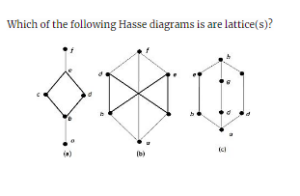 Correct
A Hasse diagram is a type of mathematical diagram used to represent a finite partially ordered set, in the form of a drawing of its transitive reduction.
Incorrect
A Hasse diagram is a type of mathematical diagram used to represent a finite partially ordered set, in the form of a drawing of its transitive reduction.
-
Question 10 of 30
10. Question
2 points“Consider the following statements. Which one is/are correct?
(i) The LU decomposition method fails if any of the diagonal elements of the matrix is zero.
(ii) The LU decomposition is guaranteed when the coefficient matrix is positive definite. “Correct
“Lower–Upper (LU) decomposition or factorization factors a matrix as the product of a lower triangular matrix and an upper triangular matrix. The product sometimes includes a permutation matrix as well. LU decomposition can be viewed as the matrix form of Gaussian elimination. Computers usually solve square systems of linear equations using LU decomposition, and it is also a key step when inverting a matrix or computing the determinant of a matrix.
1. The LU decomposition method fails if any of the diagonal elements of the matrix is zero.
2. The LU decomposition is guaranteed when the coefficient matrix is positive definite. “Incorrect
“Lower–Upper (LU) decomposition or factorization factors a matrix as the product of a lower triangular matrix and an upper triangular matrix. The product sometimes includes a permutation matrix as well. LU decomposition can be viewed as the matrix form of Gaussian elimination. Computers usually solve square systems of linear equations using LU decomposition, and it is also a key step when inverting a matrix or computing the determinant of a matrix.
1. The LU decomposition method fails if any of the diagonal elements of the matrix is zero.
2. The LU decomposition is guaranteed when the coefficient matrix is positive definite. “ -
Question 11 of 30
11. Question
2 points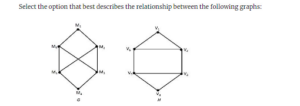 Correct
“If G1 ≡ G2 then
1. |V(G1)| = |V(G2)|
2. |E(G1)| = |E(G2)|
3. Degree sequences of G1 and G2 are same.
4. If the vertices {V1, V2, … Vk} form a cycle of length K in G1, then the vertices {f(V1), f(V2), … f(Vk)} should form a cycle of length K in G2
→ Graph G and H are having same number of vertices and edges. So, it satisfied first rule.
→ u1 degree 2, u2 degree 3, u3 degree 3, u4 degree 2, u5 degree 3, u6 degree 3.
→ V1 degree 2, V2 degree 3, V3 degree 3, V4 degree 2, V5 degree 3, V6 degree 3.
→ But it violates the property of number of cycles. The number of cycles are not same. “Incorrect
“If G1 ≡ G2 then
1. |V(G1)| = |V(G2)|
2. |E(G1)| = |E(G2)|
3. Degree sequences of G1 and G2 are same.
4. If the vertices {V1, V2, … Vk} form a cycle of length K in G1, then the vertices {f(V1), f(V2), … f(Vk)} should form a cycle of length K in G2
→ Graph G and H are having same number of vertices and edges. So, it satisfied first rule.
→ u1 degree 2, u2 degree 3, u3 degree 3, u4 degree 2, u5 degree 3, u6 degree 3.
→ V1 degree 2, V2 degree 3, V3 degree 3, V4 degree 2, V5 degree 3, V6 degree 3.
→ But it violates the property of number of cycles. The number of cycles are not same. “ -
Question 12 of 30
12. Question
2 pointsLet G be a simple undirected graph on n=3x vertices (x>=1) with chromatic number 3, then maximum number of edges in G is:
Correct
“Given undirected graph on n=3x vertices (x>=1) with chromatic number 3.
→ Maximum number of edges are=n. “Incorrect
“Given undirected graph on n=3x vertices (x>=1) with chromatic number 3.
→ Maximum number of edges are=n. “ -
Question 13 of 30
13. Question
2 points“Consider two matrices M1 and M2 with M1*M2 =0 and M1 is non singular. Then which of the following is true?
Correct
“M2 is null Matrix
The easiest way we can prove this is by looking at the determinant, since det(AB)=det(A)det(B)
and a matrix A is singular iff det(A)=0 “Incorrect
“M2 is null Matrix
The easiest way we can prove this is by looking at the determinant, since det(AB)=det(A)det(B)
and a matrix A is singular iff det(A)=0 “ -
Question 14 of 30
14. Question
2 points“Considering an undirected graph, which of the following statements is/are true?
(i) Number of vertices of odd degree is always even
(ii) Sum of degrees of all the vertices is always even “Correct
“True: Number of vertices of odd degree is always even.
True: Sum of degrees of all the vertices is always even. “Incorrect
“True: Number of vertices of odd degree is always even.
True: Sum of degrees of all the vertices is always even. “ -
Question 15 of 30
15. Question
2 pointsWhen the sum of all possible two digit numbers formed from three different one digit natural numbers are divided by sum of the original three numbers, the result is:
Correct
“Let a,b,c be 3 different digits, the sum of the different 2 digit numbers formed with them is
=(a*10+b)+(b*10+a)+(a*10+c)+(c*10+a)+(b*10+c)+(c*10+b)
=2(a+b+c)(10+1)
=22 “Incorrect
“Let a,b,c be 3 different digits, the sum of the different 2 digit numbers formed with them is
=(a*10+b)+(b*10+a)+(a*10+c)+(c*10+a)+(b*10+c)+(c*10+b)
=2(a+b+c)(10+1)
=22 “ -
Question 16 of 30
16. Question
2 pointsWhat is the chromatic number of an n-vertex simple connected graph, which does NOT contain any odd-length cycle?
Correct
“→ If n ≥ 2 and there are no odd length cycles, Then it is bipartite graph.
→ A bipartite graph has the chromatic number 2.
Eg: Consider a square, which has 4 edges. It can be represented as bipartite ,with chromatic number 2. “Incorrect
“→ If n ≥ 2 and there are no odd length cycles, Then it is bipartite graph.
→ A bipartite graph has the chromatic number 2.
Eg: Consider a square, which has 4 edges. It can be represented as bipartite ,with chromatic number 2. “ -
Question 17 of 30
17. Question
2 pointsThe average rate of convergence of the bisection method is ____.
Correct
The average rate of convergence of the bisection method is 1/2.
Incorrect
The average rate of convergence of the bisection method is 1/2.
-
Question 18 of 30
18. Question
2 pointsThe number of integers between 1 and 500(both inclusive) that are divisible by 3 or 5 or 7 is__
Correct
Draw venn diagrams and you will find option 3 is the correct one
Incorrect
Draw venn diagrams and you will find option 3 is the correct one
-
Question 19 of 30
19. Question
2 points“Which one is the correct translation of the following statement into mathematical logic?
“”None of my friends are perfect”” “Correct
“F(x) ⇒ x is my friend
P(x) ⇒ x is perfect
There doesn’t exist any person who is my friend and perfect “Incorrect
“F(x) ⇒ x is my friend
P(x) ⇒ x is perfect
There doesn’t exist any person who is my friend and perfect “ -
Question 20 of 30
20. Question
2 pointsA graph G is dual if and only if G is a ___
Correct
“Definition Given a plane graph G, the dual graph G* is the plane graph whose vtcs are the faces of G.
→ The correspondence between edges of G and those of G* is as follows:
if e∈E(G) lies on the boundaries of faces X and Y, then the endpts of the dual edge e*∈(G*) are the vertices x and y that represent faces X and Y of G. “Incorrect
“Definition Given a plane graph G, the dual graph G* is the plane graph whose vtcs are the faces of G.
→ The correspondence between edges of G and those of G* is as follows:
if e∈E(G) lies on the boundaries of faces X and Y, then the endpts of the dual edge e*∈(G*) are the vertices x and y that represent faces X and Y of G. “ -
Question 21 of 30
21. Question
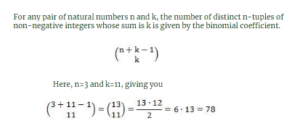
2 pointsHow many solutions does the equation x + y – z = 11 have, where x, y and z are non negative integers?
Correct
 Incorrect
-
Question 22 of 30
22. Question
2 pointsLet G be a complete undirected graph on 8 vertices of G are labelled, then the number of distinct cycles of length 5 in G is equal to:
Correct
“Given data,
8 vertices and distinct cycles length=5
Step-1: To find number of distinct cycles
C(n,r)=C(8,5)
=8! / (5!(8−5)!)
= 56 “Incorrect
“Given data,
8 vertices and distinct cycles length=5
Step-1: To find number of distinct cycles
C(n,r)=C(8,5)
=8! / (5!(8−5)!)
= 56 “ -
Question 23 of 30
23. Question
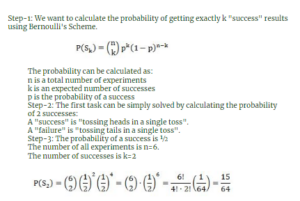
2 pointsA fair coin is tossed 6 times. What is the probability that exactly two heads will occur?
Correct
 Incorrect
-
Question 24 of 30
24. Question
2 pointsEvery cut set of a connected euler graph has____
Correct
If every minimal cut has an even number of edges, then in particular the degree of each vertex is even. Since the graph is connected, that means it is Eulerian.
Incorrect
If every minimal cut has an even number of edges, then in particular the degree of each vertex is even. Since the graph is connected, that means it is Eulerian.
-
Question 25 of 30
25. Question
2 pointsIn how many ways 8 girl and 8 boys can sit around a circular table so that no two boys sit together?
Correct
“→ First fix one boy and place other 7 in alternative seats so total ways is 7! Because they are seated in circular table. (n-1)!.
→ Now place each girl between a pair of boys. So, total ways of seating arrangement of girls is 8!
→ Finally, 7!8! Possible ways are possible. “Incorrect
“→ First fix one boy and place other 7 in alternative seats so total ways is 7! Because they are seated in circular table. (n-1)!.
→ Now place each girl between a pair of boys. So, total ways of seating arrangement of girls is 8!
→ Finally, 7!8! Possible ways are possible. “ -
Question 26 of 30
26. Question
2 pointsFind the smallest number y such that y*162 (y multiplied by 162) is perfect cube:
Correct
“Prime factorize: 162
⇒162 =2×3×3×3×3 = 33×(2×3)
For (2×3) to be a perfect cube, it should be multiplied by (22×32)
∴ Required number = y = 22×32 = 36 “Incorrect
“Prime factorize: 162
⇒162 =2×3×3×3×3 = 33×(2×3)
For (2×3) to be a perfect cube, it should be multiplied by (22×32)
∴ Required number = y = 22×32 = 36 “ -
Question 27 of 30
27. Question
2 pointsThe convergence of the bisection method is
Correct
The convergence of the bisection method is very slow. Although the error, in general, does not decrease monotonically, the average rate of convergence is 1/2 and so, slightly changing the definition of order of convergence, it is possible to say that the method converges linearly with rate 1/2.
Incorrect
The convergence of the bisection method is very slow. Although the error, in general, does not decrease monotonically, the average rate of convergence is 1/2 and so, slightly changing the definition of order of convergence, it is possible to say that the method converges linearly with rate 1/2.
-
Question 28 of 30
28. Question
2 pointsM is a square matrix of order ‘n’ and its determinant value is 5, If all the elements of M are multiplied by 2, its determinant value becomes 40. he value of ‘n’ is
Correct
M has n rows. If all the elements of a row are multiplied by , the determinant value becomes 2*5. Multiplying all the n rows by 2, will make the determinant value 2 n *5=40. Solving n= 3.
Incorrect
M has n rows. If all the elements of a row are multiplied by , the determinant value becomes 2*5. Multiplying all the n rows by 2, will make the determinant value 2 n *5=40. Solving n= 3.
-
Question 29 of 30
29. Question
2 points“Which of the following statements is/are correct?
(i) If the rank of the matrix of given vectors is equal to the number of vectors, then the vectors are linearly independent.
(ii) If the rank of the matrix of given vectors is less than the number of vectors, then the vectors are linearly dependent. “Correct
“The Rank of a Matrix
→ You can think of an r x c matrix as a set of r row vectors, each having c elements; or you can think of it as a set of c column vectors, each having r elements.
→ The rank of a matrix is defined as (a) the maximum number of linearly independent column vectors in the matrix or (b) the maximum number of linearly independent row vectors in the matrix. Both definitions are equivalent.
For an r x c matrix,
1. If r is less than c, then the maximum rank of the matrix is r.
2. If r is greater than c, then the maximum rank of the matrix is c.
→ The rank of a matrix would be zero only if the matrix had no elements. If a matrix had even one element, its minimum rank would be one. “Incorrect
“The Rank of a Matrix
→ You can think of an r x c matrix as a set of r row vectors, each having c elements; or you can think of it as a set of c column vectors, each having r elements.
→ The rank of a matrix is defined as (a) the maximum number of linearly independent column vectors in the matrix or (b) the maximum number of linearly independent row vectors in the matrix. Both definitions are equivalent.
For an r x c matrix,
1. If r is less than c, then the maximum rank of the matrix is r.
2. If r is greater than c, then the maximum rank of the matrix is c.
→ The rank of a matrix would be zero only if the matrix had no elements. If a matrix had even one element, its minimum rank would be one. “ -
Question 30 of 30
30. Question
2 points Let N={1,2,3,…} be ordered by divisibility, which of the following subset is totally ordered?
Correct
“A binary relation R on a set A is a total order on A iff R is a connected partial order on A.
“Incorrect
“A binary relation R on a set A is a total order on A iff R is a connected partial order on A.
“
- Next Quiz Daily at navclasses.in 12 PM
- Paper 2 Sunday at navclasses.in
Study Paper 1 Topics for Free Click Here
Get subscription for Complete Preparation NTA NET JRF: https://unacademy.com/subscribe/TEWDQ
use my referral code for 10% additional discount: NAVCLASSES
Search Navdeep Kaur and start watching ongoing courses
NTA NET Paper 1
Paper 2 CS Discrete Structures and Optimization Part 5
Quiz-summary
0 of 30 questions completed
Questions:
- 1
- 2
- 3
- 4
- 5
- 6
- 7
- 8
- 9
- 10
- 11
- 12
- 13
- 14
- 15
- 16
- 17
- 18
- 19
- 20
- 21
- 22
- 23
- 24
- 25
- 26
- 27
- 28
- 29
- 30
Information
Paper 1 Quiz helps u to Excel in NET JRF
Paper 1 All questions 2 Marks each
- Navdeep Kaur
- All the Best
You have already completed the quiz before. Hence you can not start it again.
Quiz is loading…
You must sign in or sign up to start the quiz.
You have to finish following quiz, to start this quiz:
Results
0 of 30 questions answered correctly
Your time:
Time has elapsed
You have reached 0 of 0 points, (0)
| Average score |
|
| Your score |
|
Categories
- Not categorized 0%
-
Average marks Improve next time All the Best
-
Nice Keep it up, Stay Blessed
-
Awesome Great Marks, Keep doing
| Pos. | Name | Entered on | Points | Result |
|---|---|---|---|---|
| Table is loading | ||||
| No data available | ||||
- 1
- 2
- 3
- 4
- 5
- 6
- 7
- 8
- 9
- 10
- 11
- 12
- 13
- 14
- 15
- 16
- 17
- 18
- 19
- 20
- 21
- 22
- 23
- 24
- 25
- 26
- 27
- 28
- 29
- 30
- Answered
- Review
-
Question 1 of 30
1. Question
2 pointsWhat is the minimum number of students in a class to be sure that three of them are born in the same month?
Correct
With the help of Pigeonhole principle we can get the solution. The idea is that if you n items and m possible containers. If n > m, then at least one container must have two items in it. So, total 13 minimum number of students.
Incorrect
With the help of Pigeonhole principle we can get the solution. The idea is that if you n items and m possible containers. If n > m, then at least one container must have two items in it. So, total 13 minimum number of students.
-
Question 2 of 30
2. Question
2 points“Which of the following statements are logically equivalent?
(i) ∀x(P(x))
(ii) ~∃x(P(x))
(iii) ~∃x(~P(x))
(iv) ∃x(~P(x)) “Correct
∀x(P(x)) = ~∃x(~P(x))
Incorrect
∀x(P(x)) = ~∃x(~P(x))
-
Question 3 of 30
3. Question
2 pointsHow many bit strings of length eight (either start with a 1 bit or end with the two bits 00) can be formed?
Correct
“Use the subtraction rule.
1. Number of bit strings of length eight that start with a 1 bit: 27 = 128
2. Number of bit strings of length eight that end with bits 00: 26 = 64
3. Number of bit strings of length eight that start with a 1 bit and end with bits 00: 25 = 32
The number is 128+64+32 = 160 “Incorrect
“Use the subtraction rule.
1. Number of bit strings of length eight that start with a 1 bit: 27 = 128
2. Number of bit strings of length eight that end with bits 00: 26 = 64
3. Number of bit strings of length eight that start with a 1 bit and end with bits 00: 25 = 32
The number is 128+64+32 = 160 “ -
Question 4 of 30
4. Question
2 pointsHow many ways are there to arrange the nine letters of the word ALLAHABAD?
Correct
“Step-1: There are 4A, 2L, 1H, 1B and 1D.
Step-2: Total number of alphabets! / alphabets are repeating using formula (n!) / (r1! r2!..).
Step-3: Repeating letters are 4A’s and 2L’s
= 9! / (4!2!)
= 7560 “Incorrect
“Step-1: There are 4A, 2L, 1H, 1B and 1D.
Step-2: Total number of alphabets! / alphabets are repeating using formula (n!) / (r1! r2!..).
Step-3: Repeating letters are 4A’s and 2L’s
= 9! / (4!2!)
= 7560 “ -
Question 5 of 30
5. Question
2 pointsThe number of the edges in a regular graph of degree ‘d’ and ‘n’ vertices is____
Correct
“Sum of degree of vertices = 2*no. of edges
d*n = 2*|E|
∴ |E| = (d*n)/2 “Incorrect
“Sum of degree of vertices = 2*no. of edges
d*n = 2*|E|
∴ |E| = (d*n)/2 “ -
Question 6 of 30
6. Question
2 pointsIf a random coin is tossed 11 times, then what is the probability that for 7th toss head appears exactly 4 times?
Correct
“→ To find probability that for the 7th toss head appears exactly 4 times. We have find that past 6 run of tosses.
→ Past 6 tosses, What happen we don’t know. But according to 7th toss, we will find that head appeared for 3 times.
→ Any coin probability of a head=½ and probability of a tail=½
→ If we treat tossing of head as success,then this leads to a case of binomial distribution.
→ According to binomial distribution, the probability that in 6 trials we get 3 success is
6C3*(½)3 *(½)3= 5/16 (3 success in 6 trials can happen in 6C3 ways). → 7th toss, The probability of obtaining a head=1/2
→ In given question is not mention that what happens after 7 tosses.
→ Probability for that for 7th toss head appears exactly 4 times is =(5/16)*(1/2)
=5/32. “Incorrect
“→ To find probability that for the 7th toss head appears exactly 4 times. We have find that past 6 run of tosses.
→ Past 6 tosses, What happen we don’t know. But according to 7th toss, we will find that head appeared for 3 times.
→ Any coin probability of a head=½ and probability of a tail=½
→ If we treat tossing of head as success,then this leads to a case of binomial distribution.
→ According to binomial distribution, the probability that in 6 trials we get 3 success is
6C3*(½)3 *(½)3= 5/16 (3 success in 6 trials can happen in 6C3 ways). → 7th toss, The probability of obtaining a head=1/2
→ In given question is not mention that what happens after 7 tosses.
→ Probability for that for 7th toss head appears exactly 4 times is =(5/16)*(1/2)
=5/32. “ -
Question 7 of 30
7. Question
2 pointsIf a planner graph, having 25 vertices divides plane into 17 different regions. Then how many edges are used to connect the vertices in this graph
Correct
“Euler’s Formula : For any polyhedron that doesn’t intersect itself (Connected Planar Graph), F(faces) + V(vertices) − E(edges) = 2.
Here as given, F=?,V=25 and E=17
→ F+25-17=2
→ 40 “Incorrect
“Euler’s Formula : For any polyhedron that doesn’t intersect itself (Connected Planar Graph), F(faces) + V(vertices) − E(edges) = 2.
Here as given, F=?,V=25 and E=17
→ F+25-17=2
→ 40 “ -
Question 8 of 30
8. Question
2 points“Total number of simple graphs that can be drawn using six vertices are:
Correct
“To get total number of simple graphs, we have a direct formula is 2(n(n-1)/2).
=26(5)/2
=215 “Incorrect
“To get total number of simple graphs, we have a direct formula is 2(n(n-1)/2).
=26(5)/2
=215 “ -
Question 9 of 30
9. Question
2 pointsCorrect
A Hasse diagram is a type of mathematical diagram used to represent a finite partially ordered set, in the form of a drawing of its transitive reduction.
Incorrect
A Hasse diagram is a type of mathematical diagram used to represent a finite partially ordered set, in the form of a drawing of its transitive reduction.
-
Question 10 of 30
10. Question
2 points“Consider the following statements. Which one is/are correct?
(i) The LU decomposition method fails if any of the diagonal elements of the matrix is zero.
(ii) The LU decomposition is guaranteed when the coefficient matrix is positive definite. “Correct
“Lower–Upper (LU) decomposition or factorization factors a matrix as the product of a lower triangular matrix and an upper triangular matrix. The product sometimes includes a permutation matrix as well. LU decomposition can be viewed as the matrix form of Gaussian elimination. Computers usually solve square systems of linear equations using LU decomposition, and it is also a key step when inverting a matrix or computing the determinant of a matrix.
1. The LU decomposition method fails if any of the diagonal elements of the matrix is zero.
2. The LU decomposition is guaranteed when the coefficient matrix is positive definite. “Incorrect
“Lower–Upper (LU) decomposition or factorization factors a matrix as the product of a lower triangular matrix and an upper triangular matrix. The product sometimes includes a permutation matrix as well. LU decomposition can be viewed as the matrix form of Gaussian elimination. Computers usually solve square systems of linear equations using LU decomposition, and it is also a key step when inverting a matrix or computing the determinant of a matrix.
1. The LU decomposition method fails if any of the diagonal elements of the matrix is zero.
2. The LU decomposition is guaranteed when the coefficient matrix is positive definite. “ -
Question 11 of 30
11. Question
2 pointsCorrect
“If G1 ≡ G2 then
1. |V(G1)| = |V(G2)|
2. |E(G1)| = |E(G2)|
3. Degree sequences of G1 and G2 are same.
4. If the vertices {V1, V2, … Vk} form a cycle of length K in G1, then the vertices {f(V1), f(V2), … f(Vk)} should form a cycle of length K in G2
→ Graph G and H are having same number of vertices and edges. So, it satisfied first rule.
→ u1 degree 2, u2 degree 3, u3 degree 3, u4 degree 2, u5 degree 3, u6 degree 3.
→ V1 degree 2, V2 degree 3, V3 degree 3, V4 degree 2, V5 degree 3, V6 degree 3.
→ But it violates the property of number of cycles. The number of cycles are not same. “Incorrect
“If G1 ≡ G2 then
1. |V(G1)| = |V(G2)|
2. |E(G1)| = |E(G2)|
3. Degree sequences of G1 and G2 are same.
4. If the vertices {V1, V2, … Vk} form a cycle of length K in G1, then the vertices {f(V1), f(V2), … f(Vk)} should form a cycle of length K in G2
→ Graph G and H are having same number of vertices and edges. So, it satisfied first rule.
→ u1 degree 2, u2 degree 3, u3 degree 3, u4 degree 2, u5 degree 3, u6 degree 3.
→ V1 degree 2, V2 degree 3, V3 degree 3, V4 degree 2, V5 degree 3, V6 degree 3.
→ But it violates the property of number of cycles. The number of cycles are not same. “ -
Question 12 of 30
12. Question
2 pointsLet G be a simple undirected graph on n=3x vertices (x>=1) with chromatic number 3, then maximum number of edges in G is:
Correct
“Given undirected graph on n=3x vertices (x>=1) with chromatic number 3.
→ Maximum number of edges are=n. “Incorrect
“Given undirected graph on n=3x vertices (x>=1) with chromatic number 3.
→ Maximum number of edges are=n. “ -
Question 13 of 30
13. Question
2 points“Consider two matrices M1 and M2 with M1*M2 =0 and M1 is non singular. Then which of the following is true?
Correct
“M2 is null Matrix
The easiest way we can prove this is by looking at the determinant, since det(AB)=det(A)det(B)
and a matrix A is singular iff det(A)=0 “Incorrect
“M2 is null Matrix
The easiest way we can prove this is by looking at the determinant, since det(AB)=det(A)det(B)
and a matrix A is singular iff det(A)=0 “ -
Question 14 of 30
14. Question
2 points“Considering an undirected graph, which of the following statements is/are true?
(i) Number of vertices of odd degree is always even
(ii) Sum of degrees of all the vertices is always even “Correct
“True: Number of vertices of odd degree is always even.
True: Sum of degrees of all the vertices is always even. “Incorrect
“True: Number of vertices of odd degree is always even.
True: Sum of degrees of all the vertices is always even. “ -
Question 15 of 30
15. Question
2 pointsWhen the sum of all possible two digit numbers formed from three different one digit natural numbers are divided by sum of the original three numbers, the result is:
Correct
“Let a,b,c be 3 different digits, the sum of the different 2 digit numbers formed with them is
=(a*10+b)+(b*10+a)+(a*10+c)+(c*10+a)+(b*10+c)+(c*10+b)
=2(a+b+c)(10+1)
=22 “Incorrect
“Let a,b,c be 3 different digits, the sum of the different 2 digit numbers formed with them is
=(a*10+b)+(b*10+a)+(a*10+c)+(c*10+a)+(b*10+c)+(c*10+b)
=2(a+b+c)(10+1)
=22 “ -
Question 16 of 30
16. Question
2 pointsWhat is the chromatic number of an n-vertex simple connected graph, which does NOT contain any odd-length cycle?
Correct
“→ If n ≥ 2 and there are no odd length cycles, Then it is bipartite graph.
→ A bipartite graph has the chromatic number 2.
Eg: Consider a square, which has 4 edges. It can be represented as bipartite ,with chromatic number 2. “Incorrect
“→ If n ≥ 2 and there are no odd length cycles, Then it is bipartite graph.
→ A bipartite graph has the chromatic number 2.
Eg: Consider a square, which has 4 edges. It can be represented as bipartite ,with chromatic number 2. “ -
Question 17 of 30
17. Question
2 pointsThe average rate of convergence of the bisection method is ____.
Correct
The average rate of convergence of the bisection method is 1/2.
Incorrect
The average rate of convergence of the bisection method is 1/2.
-
Question 18 of 30
18. Question
2 pointsThe number of integers between 1 and 500(both inclusive) that are divisible by 3 or 5 or 7 is__
Correct
Draw venn diagrams and you will find option 3 is the correct one
Incorrect
Draw venn diagrams and you will find option 3 is the correct one
-
Question 19 of 30
19. Question
2 points“Which one is the correct translation of the following statement into mathematical logic?
“”None of my friends are perfect”” “Correct
“F(x) ⇒ x is my friend
P(x) ⇒ x is perfect
There doesn’t exist any person who is my friend and perfect “Incorrect
“F(x) ⇒ x is my friend
P(x) ⇒ x is perfect
There doesn’t exist any person who is my friend and perfect “ -
Question 20 of 30
20. Question
2 pointsA graph G is dual if and only if G is a ___
Correct
“Definition Given a plane graph G, the dual graph G* is the plane graph whose vtcs are the faces of G.
→ The correspondence between edges of G and those of G* is as follows:
if e∈E(G) lies on the boundaries of faces X and Y, then the endpts of the dual edge e*∈(G*) are the vertices x and y that represent faces X and Y of G. “Incorrect
“Definition Given a plane graph G, the dual graph G* is the plane graph whose vtcs are the faces of G.
→ The correspondence between edges of G and those of G* is as follows:
if e∈E(G) lies on the boundaries of faces X and Y, then the endpts of the dual edge e*∈(G*) are the vertices x and y that represent faces X and Y of G. “ -
Question 21 of 30
21. Question
2 pointsHow many solutions does the equation x + y – z = 11 have, where x, y and z are non negative integers?
Correct
Incorrect
-
Question 22 of 30
22. Question
2 pointsLet G be a complete undirected graph on 8 vertices of G are labelled, then the number of distinct cycles of length 5 in G is equal to:
Correct
“Given data,
8 vertices and distinct cycles length=5
Step-1: To find number of distinct cycles
C(n,r)=C(8,5)
=8! / (5!(8−5)!)
= 56 “Incorrect
“Given data,
8 vertices and distinct cycles length=5
Step-1: To find number of distinct cycles
C(n,r)=C(8,5)
=8! / (5!(8−5)!)
= 56 “ -
Question 23 of 30
23. Question
2 pointsA fair coin is tossed 6 times. What is the probability that exactly two heads will occur?
Correct
Incorrect
-
Question 24 of 30
24. Question
2 pointsEvery cut set of a connected euler graph has____
Correct
If every minimal cut has an even number of edges, then in particular the degree of each vertex is even. Since the graph is connected, that means it is Eulerian.
Incorrect
If every minimal cut has an even number of edges, then in particular the degree of each vertex is even. Since the graph is connected, that means it is Eulerian.
-
Question 25 of 30
25. Question
2 pointsIn how many ways 8 girl and 8 boys can sit around a circular table so that no two boys sit together?
Correct
“→ First fix one boy and place other 7 in alternative seats so total ways is 7! Because they are seated in circular table. (n-1)!.
→ Now place each girl between a pair of boys. So, total ways of seating arrangement of girls is 8!
→ Finally, 7!8! Possible ways are possible. “Incorrect
“→ First fix one boy and place other 7 in alternative seats so total ways is 7! Because they are seated in circular table. (n-1)!.
→ Now place each girl between a pair of boys. So, total ways of seating arrangement of girls is 8!
→ Finally, 7!8! Possible ways are possible. “ -
Question 26 of 30
26. Question
2 pointsFind the smallest number y such that y*162 (y multiplied by 162) is perfect cube:
Correct
“Prime factorize: 162
⇒162 =2×3×3×3×3 = 33×(2×3)
For (2×3) to be a perfect cube, it should be multiplied by (22×32)
∴ Required number = y = 22×32 = 36 “Incorrect
“Prime factorize: 162
⇒162 =2×3×3×3×3 = 33×(2×3)
For (2×3) to be a perfect cube, it should be multiplied by (22×32)
∴ Required number = y = 22×32 = 36 “ -
Question 27 of 30
27. Question
2 pointsThe convergence of the bisection method is
Correct
The convergence of the bisection method is very slow. Although the error, in general, does not decrease monotonically, the average rate of convergence is 1/2 and so, slightly changing the definition of order of convergence, it is possible to say that the method converges linearly with rate 1/2.
Incorrect
The convergence of the bisection method is very slow. Although the error, in general, does not decrease monotonically, the average rate of convergence is 1/2 and so, slightly changing the definition of order of convergence, it is possible to say that the method converges linearly with rate 1/2.
-
Question 28 of 30
28. Question
2 pointsM is a square matrix of order ‘n’ and its determinant value is 5, If all the elements of M are multiplied by 2, its determinant value becomes 40. he value of ‘n’ is
Correct
M has n rows. If all the elements of a row are multiplied by , the determinant value becomes 2*5. Multiplying all the n rows by 2, will make the determinant value 2 n *5=40. Solving n= 3.
Incorrect
M has n rows. If all the elements of a row are multiplied by , the determinant value becomes 2*5. Multiplying all the n rows by 2, will make the determinant value 2 n *5=40. Solving n= 3.
-
Question 29 of 30
29. Question
2 points“Which of the following statements is/are correct?
(i) If the rank of the matrix of given vectors is equal to the number of vectors, then the vectors are linearly independent.
(ii) If the rank of the matrix of given vectors is less than the number of vectors, then the vectors are linearly dependent. “Correct
“The Rank of a Matrix
→ You can think of an r x c matrix as a set of r row vectors, each having c elements; or you can think of it as a set of c column vectors, each having r elements.
→ The rank of a matrix is defined as (a) the maximum number of linearly independent column vectors in the matrix or (b) the maximum number of linearly independent row vectors in the matrix. Both definitions are equivalent.
For an r x c matrix,
1. If r is less than c, then the maximum rank of the matrix is r.
2. If r is greater than c, then the maximum rank of the matrix is c.
→ The rank of a matrix would be zero only if the matrix had no elements. If a matrix had even one element, its minimum rank would be one. “Incorrect
“The Rank of a Matrix
→ You can think of an r x c matrix as a set of r row vectors, each having c elements; or you can think of it as a set of c column vectors, each having r elements.
→ The rank of a matrix is defined as (a) the maximum number of linearly independent column vectors in the matrix or (b) the maximum number of linearly independent row vectors in the matrix. Both definitions are equivalent.
For an r x c matrix,
1. If r is less than c, then the maximum rank of the matrix is r.
2. If r is greater than c, then the maximum rank of the matrix is c.
→ The rank of a matrix would be zero only if the matrix had no elements. If a matrix had even one element, its minimum rank would be one. “ -
Question 30 of 30
30. Question
2 points Let N={1,2,3,…} be ordered by divisibility, which of the following subset is totally ordered?
Correct
“A binary relation R on a set A is a total order on A iff R is a connected partial order on A.
“Incorrect
“A binary relation R on a set A is a total order on A iff R is a connected partial order on A.
“